The importance of computers in your child's life
December 16, 2014
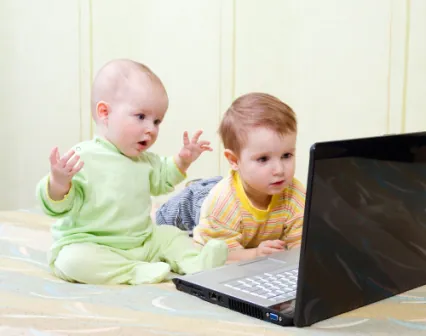
The importance of computers in your child's life
1. The child’s use of educational programs provides him with the technique of imagination and vision, which is what the child needs to practice in his early life, and as Einstein said, “Imagination is more important than information.”
2. The child’s use of the computer gives him a sense of control over the sequence of the program level, in the next step he wants to follow, and thus he feels self-confident.
3. He uses logic through trial and error, and this helps him to think logically and analytically because it reinforces the concept that inputting correct logical data produces similar results.
4. It contributes to encouraging the child to use language and to match the language used with visual objects through text, image and sound programs.
5. There are several activities that children can do, such as: encouraging them to write poetry by stimulating their imagination, designing a chart showing the family tree, publishing stories they create in a book, programming a story from the fabric of their imagination, in which they talk about their adventures using a specific programming language, drawing a specific scene that appeals to them or expresses their feelings.
6. Through group learning programs, children learn collaborative learning and how to participate in solving problems. Group learning begins with basic knowledge and then recalls previous experiences related to that knowledge. As the saying goes, "Two heads are better than one." Group learning is based on two principles: first, reliance on social interaction and the exchange of knowledge and experiences; second, learning by doing. 7. Computers benefit children by increasing their self-confidence and developing their leadership abilities through their control of the device.
One of the factors that contributes to a child's self-confidence is their knowledge of various sciences and arts, which makes them feel superior and distinguished from their peers, and capable of doing many things that other children cannot. Research conducted at MIT has shown that computers can instill a sense of accomplishment and positive feelings in children suffering from low self-esteem. This is the feeling one experiences when achieving a desired goal. Furthermore, the sense of control and taking on an active role—a positive, interactive role rather than a passive and dependent one—gives them a feeling of superiority and distinction. Ms. Angela Newby, a computer specialist at a well-known international school, says that using educational computer games helps children gain self-confidence and self-esteem because these games allow each child to control their experience, their rate of progress, and choose the level of challenge that suits them.
8. Computers contribute to creating a fun learning environment. They encourage independent learning and enhance creative thinking skills by utilizing and strengthening brain cells. Angela emphasizes, “It’s important to remember that not all computer games are bad. Many educational games enable children to develop and practice various skills. For example, they can teach letters, numbers, shapes, colors, and rhythm. When children start school, they can also use games related to their school subjects. Good games allow children to practice problem-solving and logic skills. These games also improve fine motor skills, coordination, and foster an interest in information technology.” Perhaps, dear parent, you are eager to help your child become a positive and active learner and want to introduce them to computers.
But now you want to know when a child is ready to learn about computers?
Answer: A child can begin using a computer usefully from the age of three, although they need some close supervision and adult assistance at first until they become independent. A three- and four-year-old can learn to turn on the computer, move the mouse, use floppy disks and CDs, access the letters on the keyboard, and follow simple on-screen instructions such as "next," "ok," and "quit." This helps them progress in learning to read and increases their desire to learn more. Perhaps, dear parent, you are now enthusiastic and have begun teaching your child—and what a wonderful parent you are! But remember: • Make sure you yourself take a computer course to be more experienced in teaching your child. • Just as there is time for play, there must also be time for learning. • Get your child used to the idea that when the call to prayer is given, we should leave everything and go to pray.